

What Makes An Animal A Mutt ?
Dogs are like water ice cream flavors: In that location'due south ane to satisfy nearly every taste.
Choose a size, say. A St. Bernard can counterbalance 100 times more than than a Chihuahua. Or pick the type of coat. Poodles accept long, curly hair; pugs have smooth, brusk coats. Or select simply well-nigh any other quality. Greyhounds are lean and fast. Pit bulls are stocky and powerful. Some dogs are dumb. Others are deadly. Some protect yous from burglars. Others rip your burrow to shreds.
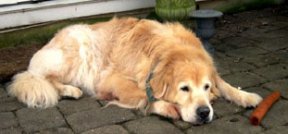
A golden retriever takes information technology easy. Eric Roell
2 dogs can look and act so differently that you might think that they belong to separate species—that they're as distinct equally, say, a rat and a kangaroo.

Nonetheless, as unlikely as the mismatched couple may seem, a tiny terrier and a giant Great Dane even so vest to the same species. As long every bit one is male person and the other is female person, whatsoever 2 dogs can mate and create a litter of puppies that look like a mix of the 2 breeds. Dogs tin can fifty-fifty mate with wolves, jackals and coyotes to produce offspring that can abound upward and accept their own babies.
To explain how and why dogs tin can differ in then many ways yet notwithstanding vest to the same species, scientists are going directly to the source: dog Deoxyribonucleic acid.
Instruction manual
DNA is similar an instruction manual for life. Every cell contains DNA molecules, and these molecules include genes, which tell cells what to practise. Genes command many aspects of an animal's looks and behavior.
This spring, researchers from the Whitehead Constitute for Biomedical Research in Cambridge, Mass., await to complete a detailed scan of the entire ready of DNA in a boxer named Tasha. They'll be able to compare the boxer'south DNA to that of a poodle. A different group of scientists analyzed a poodle's Deoxyribonucleic acid final fall (see http://sciencenewsforkids.org/articles/20031001/Note3.asp ). Others are starting to piece of work on Dna belonging to each of three other dogs: a mastiff, a bloodhound, and a greyhound.
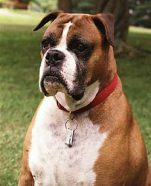
Scientists are analyzing the DNA of Tasha, a female person boxer. NHGRI
A wealth of of import information lies inside the genes of dogs. Already, analyses of dog DNA are helping to explain when and how wolves first left the wild and became pets. In the hereafter, pinpointing which genes do what may help breeders create calmer, cuter, or healthier dogs.
The wellness of people may exist at pale, too. Dogs and people suffer from almost 400 of the same diseases, including heart disease and epilepsy, says Norine Noonan of the Higher of Charleston in South Carolina.
Dogs may be helpful for studying a variety of man diseases. It's not even necessary to keep dogs in the lab, says geneticist Gordon Lark of the University of Utah in Salt Lake City. A uncomplicated blood test or saliva sample is enough for researchers to excerpt DNA for analysis.
"Cancer is the number 1 killer of dogs after historic period 10," Noonan says. "By agreement cancer in dogs, perhaps we can find a window into understanding cancer in humans."
"This is the current disease borderland," Lark says.
Dog variety
Belonging to as many as 400 different breeds, dogs are perchance the most various species of animal on Earth. They're likewise one of the most vulnerable to ailments, having more than genetic bug than nearly whatsoever other animal.
These problems spring in large part from the breeding process itself. To create a new type of canis familiaris, a breeder typically mates dogs that share a particular trait, such every bit snout length or running speed. When puppies are built-in, the breeder selects the ones that accept the longest snouts or run fastest to mate in the next round. This goes on for generations, until a new brood of long-snouted or super-fast dogs makes its way into competitions and pet stores.
By choosing dogs that look or human action a certain way, the breeder is also choosing genes that control those traits. At the same fourth dimension, though, genes that cause diseases can get concentrated in the population. The more closely related ii animals are, the college are the chances that their offspring will suffer genetic diseases or other issues.
Different breeds tend to have different issues. Greyhounds' very light basic make them fast, simply a greyhound can break its legs merely by running. Dalmatians often become deaf. Centre affliction is mutual in boxers. Labradors have hip bug.
In Jan, researchers in the United kingdom started to survey how common domestic dog diseases are in diverse breeds. With the promise of designing meliorate screening and treatment programs, the scientists take asked more than 70,000 dog-owners to provide data about their dogs.
Best friend
Studying dog genes may also help explain when and how dogs became "man's best friend."
No ane knows for sure how it happened, only one pop story goes like this: About 15,000 years ago in central Russia, our ancestors were sitting around a burn. A specially brave wolf crept closer and closer, fatigued by the scent of food. Feeling sympathetic, someone threw a leftover os or scrap of food to the animal.
Eager for more food, the wolf and its pals began to follow homo hunters from place to identify, flushing out game for them. As a reward, people took intendance of the animals and fed them. Eventually, wolves moved into the man community, and a relationship began. Tameness was the showtime trait people selected for. Dissimilar shapes, sizes, colors, and temperaments came later. The modernistic dog was born.
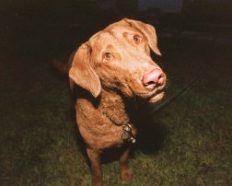 The Chesapeake Bay Retriever is known as an intensely loyal, protective, sensitive, and serious working dog. Shawn Sidebottom |
Recent genetic analyses suggest that domestication probably happened independently in six places in Asia, says Deborah Lynch of the Canine Studies Institute in Aurora, Ohio.
Some researchers speculate that wolves may have tamed themselves only past hanging around Stone Age garbage dumps. Wolves that weren't scared off by people had a better gamble of getting nutrient and surviving.
At that place'due south also genetic show suggesting that tameness itself goes together with changes in body chemistry that let for a greater variety of body shape, coat color, and other traits among dogs.
Solving issues
New information virtually dog genetics is helping scientists find ways to rid dogs of sure undesirable types of behavior.
Burmese mountain dogs are one example, Noonan says. The muscular dogs used to be extremely aggressive. Through a careful study of heredity, scientists tracked downwards a gene responsible for this assailment and bred dogs that don't take it.
Other behaviors may be more hard to chuck out. "We know of no genes for peeing in the firm or chewing up shoes," Noonan says.
Some things may never change.
Source: https://www.sciencenewsforstudents.org/article/what-makes-dog
Posted by: vandeusenunatesures.blogspot.com
0 Response to "What Makes An Animal A Mutt ?"
Post a Comment