

What Percentage Of Wild Animals Are In Captivity
The Dangers of Keeping Exotic Pets
Exotic animals — lions, tigers, wolves, bears, reptiles, not-human primates — belong in their natural habitats and not in the easily of private individuals equally "pets." By their very nature, these animals are wild and potentially dangerous and, every bit such, practice non conform well to a captive environment.
Because the majority of states do not keep accurate records of exotic animals entering their land, it is impossible to determine exactly how many exotic animals are privately held as pets, simply the number is estimated to exist quite loftier. An estimated v,000 tigers lone are held past individual individuals.
The American Veterinary Medical Association, the Us Department of Agronomics (USDA), and the Centers for Illness Control and Prevention (CDC) have all expressed opposition to the possession of certain exotic animals by individuals.
Exotic animals practice not make skillful companions. They require special intendance, housing, nutrition, and maintenance that the boilerplate person cannot provide. When in the hands of private individuals, the animals suffer due to poor care. They likewise pose safe and health risks to their owners and any person coming into contact with them.
Individuals possessing exotic animals oft attempt to change the nature of the fauna rather than the nature of the care provided. Such tactics include solitude in minor, barren enclosures, chaining, beating "into submission," or even painful mutilations, such as declawing and molar removal.
If and when the individual realizes he/she can no longer treat an exotic pet, he/she usually turns to zoos and other institutions such as sanctuaries to relieve him/her of the responsibility. However, all the zoos and accredited institutions could not possibly accommodate the number of unwanted exotic animals. Consequently, the majority of these animals are euthanized, abandoned, or doomed to alive in deplorable conditions.
The Exotic Beast Pet Trade

Every year, a variety of sources provides millions of animals to the exotic pet trade. Animals are captured from their native habitats and transported to various countries to exist sold every bit pets. Others are surplus animals from zoos or their offspring. Backyard breeders also supply exotic animals.
It is absurdly like shooting fish in a barrel to obtain an exotic pet. More than 1,000 Internet sites offer to sell, give intendance advice, and provide chat rooms where buyers and sellers tin can haggle over a price. Helping to facilitate the exotic pet trade is the Animal Finders' Guide, which carries ads from dealers, private parties, breeders, ranchers, and zoos offering big cats, monkeys, and other exotic animals for sale.
The sellers of these animals, however, make no mention of the state or local laws regulating private possession of exotics, or of the dangers, difficulties, physical and physiological needs of the animals they peddle. The suffering of the animals in the easily of unqualified and hapless buyers appears to be of no concern in the lucrative exotic pet trade.
Public Prophylactic Risk
Exotic animals are inherently dangerous to the individuals who possess them, to their neighbors, and to the community at large. Across the country, many incidents have been reported where exotic animals held in private easily attacked humans and other animals, and escaped from their enclosures and freely roamed the community. Children and adults have been mauled by tigers, bitten by monkeys, and asphyxiated by snakes.
By their very nature, exotic animals are dangerous. Although well-nigh exotic animals are territorial and require group interactions, an exotic pet typically is isolated and spends the majority of his/her day in a small enclosure unable to roam and express natural behaviors freely. These animals are time bombs waiting to explode.
Monkeys are the most common non-human primates held by private individuals. At the age of two, monkeys begin to exhibit unpredictable beliefs. Males tend to become ambitious, and both males and females bite to defend themselves and to establish authorisation. Reported have been many monkey bites that resulted in serious injury to the private who possessed the animal, to a neighbour, or to a stranger on the street. Co-ordinate to the CDC, 52 people reported being bitten past macaque monkeys between 1990 to 1997. CDC reported, however, that "owners of pet macaques are often reluctant to study bite injuries from their pets, even to their medical care providers" for fear that their animal will exist confiscated and possibly killed.
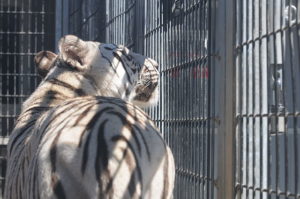
Not-domesticated felines, such equally lions, tigers, leopards, and cougars, are commonly held as pets. These exotic animals are cute and cuddly when they are immature just take the potential to kill or seriously injure people and other animals as they grow. Even a seemingly friendly and loving animal tin can set on unsuspecting individuals. Many large cats have escaped from their cages and terrorized communities. Several of these incidents accept resulted in either serious injury to the persons who came in contact with the animal, or the expiry of the animal, or both.
Reptiles, including all types of snakes and lizards, pose safety risks to humans as well. Many incidents have been reported of escapes, strangulations, and bites from pet reptiles beyond the country. Snakes are the nigh common "pet" reptiles — nigh 3% of U.S. households possess 7.iii million pet reptiles — and have the potential to inflict serious injury through a bite or constriction. Co-ordinate to the University of Florida, more than than 7,000 venomous ophidian bites are reported annually in the Us (it is uncertain how many of these snakes are pets), 15 of which result in expiry. Moreover, there have been several reported incidences involving strangulation by snakes. For example, on August 28, 1999, in Centralia, IL, a 3-yr-onetime boy was strangled to death past the family's pet python. The parents were charged with child endangerment and unlawful possession of a dangerous beast.
Man Wellness Take chances
Exotic animals pose serious health risks to humans. Many exotic animals are carriers of zoonotic diseases, such as Herpes B, Monkey Pox, and Salmonellosis, all of which are catching to humans.
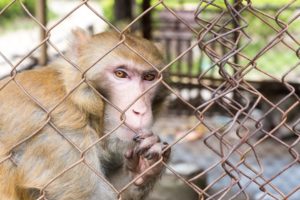
Canker B-virus: 80 to ninety percent of all macaque monkeys are infected with Canker B-virus or Simian B, a virus that is harmless to monkeys merely oftentimes fatal in humans. Monkeys shed the virus intermittently in saliva or genital secretions, which generally occur when the monkey is ill, under stress, or during breeding season. At whatsoever given fourth dimension, most ii% of infected macaque monkeys are shedding the virus. A person who is bitten, scratched, or sneezed or spit on while shedding occurs runs the risk of contracting the disease. Monkeys rarely show any signs or symptoms of shedding, making it nearly impossible to know when i is at risk.
Reported cases of infection in humans are very rare; since the identification of the virus in 1932, there take only been 31 documented human infections by B virus, 21 of which were fatal. According to the CDC, the reason for "such an plainly low rate of transmission may include infrequent B virus shedding by macaques, cross-reactive immunity against B virus stimulated by herpes simplex virus infection, and undetected asymptomatic infection." All the same, the frequency of Herpes B infection in humans has never been adequately studied and thus it is difficult to quantify how many people are actually infected with the virus. Persons who possess or work with infected monkeys are presumed to be in abiding peril of potentially contracting the virus.
Bites from not-human primates can cause severe lacerations. Wounds may become infected, with the potential to reach the os and cause permanent deformity. The frequency of bites remains a mystery. Although it is widely best-selling that non-human primate bites are some of the worst animal bites, little research regarding them exists.
Monkeys have also been known to transmit the Ebola virus, monkey pox, and other deadly illnesses.
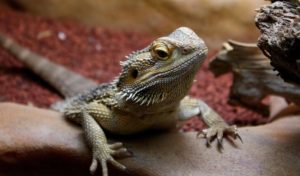
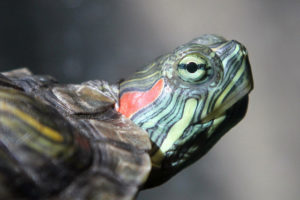
Salmonellosis: Probably 90 percent of all reptiles acquit and shed salmonella in their carrion. Iguanas, snakes, lizards, and turtles are common carriers of the bacterium. Reptiles that deport salmonella do not prove any symptoms, thus there is no simple style to tell which reptiles play host to the microbe and which practice not, because fifty-fifty those that have it do not constantly shed the bacterium.
Salmonellosis associated with exotic pets has been described as one of the most important public health diseases affecting more people and animals than any other single disease. The CDC estimates that 93,000 salmonella cases caused by exposure to reptiles are reported each twelvemonth in the United States.
Salmonella infection is caused when individuals consume later failing to launder their easily properly afterwards handling a reptile or objects the reptile contaminated (this can exist either indirect or direct contact with infected reptiles). Salmonella bacteria do not make the beast sick, merely in people can cause serious cases of severe diarrhea (with or without blood), headache, malaise, nausea, fever, vomiting, abdominal cramps, and even death — especially in immature children, the elderly, and those with immune-compromised systems. In addition, salmonella infection can result in sepsis and meningitis (specially in children) as well as invade the intestinal mucosa and enter the bloodstream causing septicemia and death.
In March 1999, the CDC contacted every state health department to make up one's mind whether state regulations existed for sale of reptiles and distribution of information about contracting salmonella from reptiles. Xl-eight states responded — iii (CA, CT, MI) had regulations requiring pet stores to provide information near salmonella to persons purchasing a turtle. Ii states (KS, Doctor) crave salmonella data to be provided to persons purchasing whatsoever reptile, and iii states (AZ, MN, WY) prohibit reptiles in 24-hour interval care centers and long-term-care facilities.
During 1996-1998, 16 different state health departments reported to the CDC salmonella infections in persons who had direct or indirect contact with pet reptiles, and in 1994-1995, 13 dissimilar land health departments reported salmonella infections. The CDC recommends that children, people with compromised immune systems, and the elderly should avoid all contact with reptiles and not possess them as pets.
Laws Governing Private Possession of Exotic Animals
The sale and possession of exotic animals is regulated by a patchwork of federal, state and local laws that generally vary by community and past animal. Individuals possessing exotic animals must be in compliance with all federal laws as well every bit whatever country, city, and county laws.
Federal Laws: Three federal laws regulate exotic animals — the Endangered Species Act, the Public Health Service Act, and the Lacey Act. However, these laws primarily regulate the importation of exotic animals into the United states and not individual possession.
Under the Endangered Species Deed (ESA) it is illegal to possess, sell, or buy an endangered species regardless to whether it'due south over the Internet or not. The ESA does non regulate private possession, information technology just allows the U.S. Fish & Wildlife Service (USFWS) to prosecute individuals who illegally possess endangered species. It should be noted that "generic" tigers (subspecies that have been interbred) are not considered endangered and, every bit such, can be legally bred and possessed.
The Public Health Services Deed prohibits the importation of non-homo primates and their offspring into the Usa afterward October 1975 for whatsoever use other than scientific, educational, or exhibition purposes.
The Lacey Human action allows the U.S. government to prosecute persons in possession of an fauna illegally obtained in a foreign country or another country. Again, this Human action does not regulate private possession, it merely allows the USFWS to prosecute individuals who accept illegally obtained exotic animals.
State Laws: The state governments possess the potency to regulate exotic animals privately held. Laws vary from country to state on the type of regulation imposed and the specific animals regulated. Some states ban private possession of exotic animals (i.e. they prohibit possession of at least big cats, wolves, bears, non-human primates, and dangerous reptiles); other states have a partial ban (i.due east. they prohibit possession of some exotic animals but not all); and others require a license or permit to possess exotic animals; and while other states neither prohibit nor require a license, they may require some information from the possessor (veterinarian certificate, certification that animal was legally acquired, etc.).
Local Laws: Many cities and counties have adopted ordinances that are more stringent than the state constabulary. Generally, the City or County Council have determined that possession of sure exotic species poses a serious threat to the health, condom, and welfare of the residents of the community as a result of a recent assault in the area, an escape, or by the virtue of the animals' physical attributes and natural behavior and, every bit such, adopts an ordinance regulating or banning private possession.
Some people oft sidestep existing laws or bans by becoming licensed breeders or exhibitors nether the USDA and/or by having their holding rezoned. In addition, individuals ofttimes move out of urban center limits or to a new country one time a restriction or ban is imposed.
What to Do
Y'all tin can do several things to help stop private possession of exotic animals:
- For the animals' sake and for your health and prophylactic, please do not buy exotic animals as "pets."
- If you find an exotic creature being driveling, living in pitiful conditions, etc., report information technology to the appropriate animal control agency.
- Brainwash others. Write a Letter to the Editor. Share this fact sheet with friends and family.
- Back up legislation at all levels to prohibit private possession of exotic animals.
- Find out how your state, city and county regulates private possession of exotic animals. If your state, urban center, or county does not prohibit private possession, contact your state senator and representative or your city and canton quango members and urge them to introduce legislation banning possession of exotic animals.
What Regime Agencies and Public Officials Are Saying
"The AVMA strongly opposes the keeping of wild carnivore species of animals [and reptiles and amphibians] equally pets and believes that all commercial traffic of these animals for such purpose should be prohibited."
The American Veterinarian Medical Clan
"Large wild and exotic cats such equally lions, tigers, cougars, and leopards are dangerous animals … Considering of these animals' potential to kill or severely injure both people and other animals, an untrained person should non go along them as pets. Doing then poses serious risks to family, friends, neighbors, and the general public. Even an creature that can exist friendly and loving can be very dangerous."
The Usa Department of Agriculture
"Pet reptiles should be kept out of households where children aged less than v years or immunocompromised persons alive. Families expecting a new kid should remove the pet reptile from the home earlier the babe arrives."
The Centers for Illness Control and Prevention
"Buying or giving exotic pets such as monkeys, hedgehogs, prairie dogs, reptiles, or other wildlife potentially can exist dangerous to both humans and the animals themselves."
Veterinary Jane Mahlow, Director of the Texas Section of Health Zoonosis Control Division
"People buy these [large cats] when they're kittens and don't have the foresight to come across in iv years that kitten is going to be 500 pounds, and instead of two bottles information technology is going to need thirty to fifty pounds of meat a day. They try to make a pet out of something that will never be a pet."
Terry Mattive of T & D Mount Range Menagerie, a sanctuary for unwanted, abused and exploited jungle cats in Penn Creek, PA
"Macaques [monkeys] are aggressive and are known to conduct diseases, including canker B, which tin exist fatal to humans … My opinion is primates make very poor pets."
Dr. Michael Cranfield, veterinarian at the Baltimore Zoo and an practiced on primates
Source: https://www.bornfreeusa.org/campaigns/animals-in-captivity/the-dangers-of-keeping-exotic-pets/
Posted by: vandeusenunatesures.blogspot.com
0 Response to "What Percentage Of Wild Animals Are In Captivity"
Post a Comment